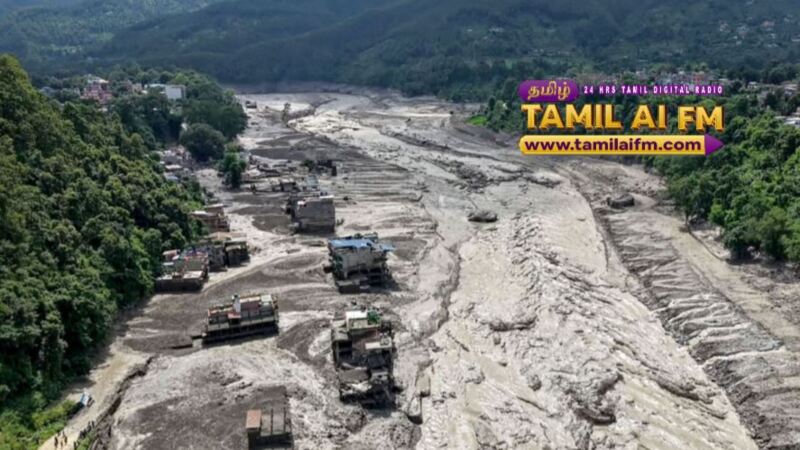
BANGKOK — A huge piece of ice that fell thousands of metres from a glacier into a river below may have unleashed the disaster in Nepal and Tibet that killed at least 180 people.
Here is what experts believe happened so far: A glacier collapse in Nepal’s mountains near Tibet appears to have triggered the disaster.
“A large chunk of glacier fell from about 5,200 metres... into a valley,” said Simon Cox, principal scientist at New Zealand’s GNS Science.
It “transformed into this raging mass of debris... where it picks up rocks and sediment and trees and anything in the way and fires it on down through the canyon,” he told AFP.
The wall of water first impacted a border post, as documented in terrifying CCTV footage showing mud and debris engulfing the area as people fled before it.It then travelled downstream into Nepal, flooding villages and bringing down bridges and buildings.
Seismic activity
The glacier collapse was large enough to register as a seismic event, initially mistaken for an earthquake.
But after further analysis, the US Geological Survey determined “that the seismic event was instead a glacial collapse and debris flow, and that no earthquake had occurred.
The collapse registered as a 5.2-magnitude “seismic event”, which took place at 8.37am local time (10.52am Malaysia time).
Estimating just how much of the glacier collapsed will take time, Cox said, but it could range from “half a million cubic metres to tens of million cubic metres.”
Detective work
With the affected area largely inaccesible, experts are using satellite imagery and any available measurements on the ground to reconstruct the disaster.
“We can look at satellite imagery taken before and after the event, and try and see what has changed, essentially looking for what is missing from the mountains in the ‘after’ imagery,” said Lauren Vargo, a glaciologist at New Zealand’s Victoria University of Wellington.