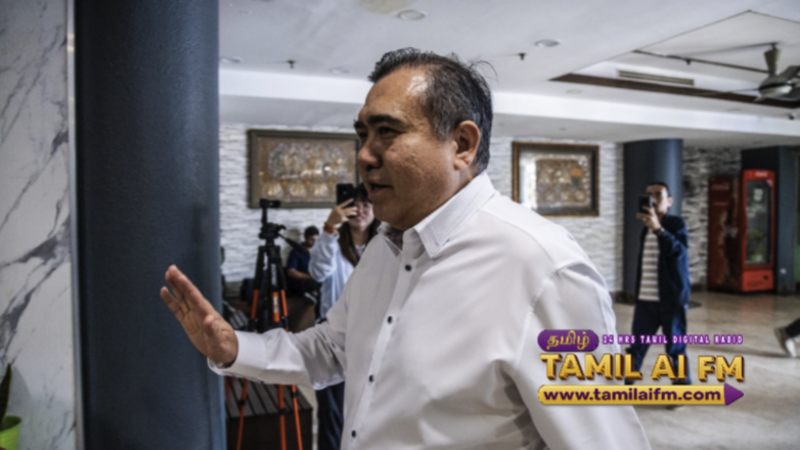
The decision of DAP secretary-general Anthony Loke to offer his resignation as Transport Minister should be understood for what it is: a serious political signal.
However, one deliberately calibrated not to become a constitutional confrontation.
Following the conditional pardon granted to former prime minister Najib Razak – allowing him to serve the remainder of his SRC International sentence under house arrest until August 23, 2028 – DAP faced an obvious dilemma.
It had to demonstrate that its long-standing position on corruption had not disappeared merely because it was now part of the Federal Government.
Yet it also had to recognise that Malaysia remains a constitutional monarchy operating through institutions, conventions and carefully delineated powers.
The pardon was granted through the constitutional pardons process chaired by the Yang di-Pertuan Agong.
Loke’s response therefore carries considerable significance.
It was measured and principled. As the Secretary General of DAP, Loke has offered to relinquish his Cabinet position while the other DAP ministers and deputy ministers remain in government.
Loke said explicitly that this was intended to register the party’s position without producing political instability.
DAP also reiterated that it respects the Yang di-Pertuan Agong’s constitutional authority over pardons.
That is sufficient.
A mass resignation would convey something fundamentally different.
If every DAP minister and deputy minister were to leave simultaneously, especially if such action threatened the survival of the government, the political meaning could easily move beyond disagreement with the treatment of Najib.
It could be perceived as a direct and frontal political challenge arising from the exercise of the monarchy’s constitutional prerogative.
This would be unwise.
Malaysia’s constitutional system was never designed to resolve every disagreement through institutional escalation.
Its genius, when functioning properly, lies precisely in the opposite direction: checks and balances, parliamentary accountability, Cabinet responsibility, judicial independence and constitutional restraint.