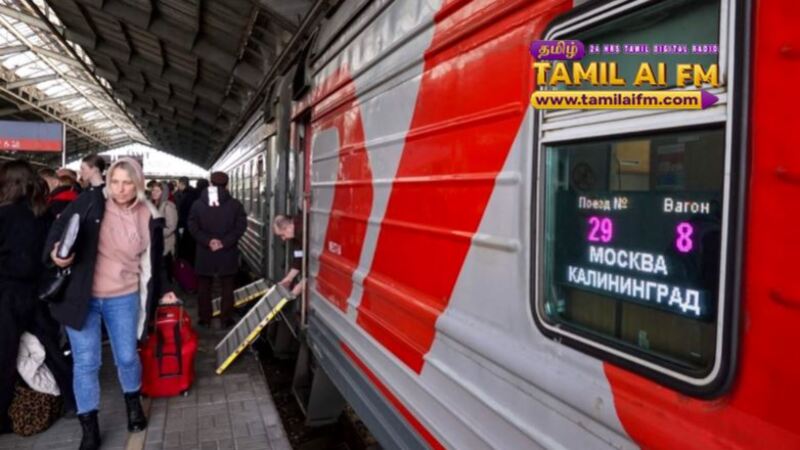
KALINIGRAD (Russia) — As the Moscow-Kaliningrad train approached Lithuania, the car attendant beckoned to passengers in Russian: “I’m closing the entire carriage, the toilets are out of action.”
The 19-hour, 1,000-kilometre (650-mile) journey is the only land route between mainland Russia and its coastal exclave of Kaliningrad, wedged on the Baltic Sea between EU and Nato members Poland and Lithuania.
In echoes of the Cold War, passengers on the “Yantar”, the Russian word for amber, are locked inside for the three hours it spends traversing Lithuania.
The Baltic state has been one of Europe’s most pro-Kyiv voices, pushing for a hard line against Russia since it ordered troops into Ukraine in February 2022. Moscow sees it as a hostile state.
Doors and windows are sealed – to prevent Russians jumping off and escaping, Vilnius says.
The toilets are only open for use while the train is speeding along, not when it stops.
“The border with Lithuania is in 30 minutes,” the assistant shouted to rouse slumbering passengers.
Though the train is half-empty, sleeping quarters are cramped and heating is blasted to the max.
Russian citizens need a visa for the EU’s Schengen zone or a special transit permit for the journey, even if they cannot set foot outside the train.
“Sometimes there are even fewer passengers. Travelling has become complicated since 2022,” one attendant, speaking anonymously, told AFP on a recent journey.
“Neither EU citizens nor Russian citizens are allowed to leave the transit train,” except in “urgent humanitarian reasons,” like if a passenger falls seriously ill, Lithuania’s State Border Guard Service told AFP in written comments.
For that reason, “the doors and windows are sealed,” an agent of the EU’s Frontex border force told AFP at a checkpoint en route.
“In the past, Russians found ways to get off the train and vanish into the wild,” the agent, speaking on condition of anonymity as he was not authorised to speak to media, told AFP as he went between compartments checking documents.